

GMOS-Train Mid-term Check Announcement!
We are pleased to announce the GMOS-Train Mid-term Check with our EC Project Officer (Ms Giuliana Donini).
The meeting will take place from October 6th – 8th 2021, in Ljubljana, in person. All those who will not be able to come to Ljubljana, will be able to attend the meeting virtually via ZOOM.
The Mid-Term Check (MTC) assesses the fulfilment of the ESR recruitment procedure, the eligibility of the fellows, any deviations of the original training programme and raises awareness on the fellows’ and host institutions’ rights and obligations. The MTC should be understood as a constructive dialogue between the network participants and the REA Project Officer and is a valuable source of feedback to both the consortium and the REA. As such, the MTC constitutes an excellent opportunity to meet the whole consortium members and address all issues which are linked to late recruitment, and changed (postponed) secondment plans due to Covid-19 worldwide pandemic situation. In case of issues, corrective actions should immediately be taken.
We will take this opportunity to organise also a network-wide meeting and a site visit of the contaminates site of the wider Idrija region. Therefore we are planning to host a three-day event.


Aye aye, Captain Mercury!

Natalia (ESR 4) was trained in clean sampling methods and ultra-trace level seawater mercury measurements at MIO from October to December 2020. She first applied the method to samples of hydrothermal vent fluids of the Midatlantic ridge that were already available. She further applied what she learnt during the GEOTRACES SWINGS cruise to the Southern Indian Ocean (January – March 2021) where she measured total Hg and dissolved gaseous mercury (DGM) onboard, and sampled for MeHg, DMHg, MMHg, pHg.


After her return, she supervised 2 MSc student internships: 1. to measure Hg concentrations of the TAG hydrothermal vent plume water from a previous cruise to the Midatlantic Ridge and 2. to measure pHg of suspended particulate matter and sediments from the SWINGS cruise. In parallel, she started experiments at MIO’s coastal observation station at Endoume to investigate the stability and potential diurnal variability of DGM. Then, she was trained in Hg isotopes extraction methods and measurements at GEToulouse.

During August 2021, Natalia joined the TARA OCEANS cruise to put in place a 1-year sampling strategy along the Southamerican and African coastlines.


Upon her return, she joined an oceanographic cruise to the Rainbow hydrothermal vent plume on RV Meteor (September to October 2021). The rest of the year is planned with laboratory analysis.


Hg0 oxidation experiments
Sreekanth joined the Institut Jožef Stefan in February 2021 and is very excited about starting his Ph.D. at the Dept. of Environmental Sciences-O2. He has been enrolled in the first-year degree program in Ecotechnologies at Jožef Stefan International Postgraduate School, completed his course work for the first year and is now enrolled for the second year.
After joining the research group, Sreekanth is being trained in various methods used in atmospheric Hg research. He has been introduced to the novel method of using 197Hg radiotracer and cold plasma in conducting laboratory Hg0 oxidation experiments. Besides, he is also trained in using the Quadrupole Mass Spectrometer to detect GOM species generated from laboratory plasma-oxidation experiments. Sreekanth has also actively participated in training programs within the scope of the GMOS-Train objectives and has completed some online courses useful for his research work.


He is now working in the laboratory on Hg0 plasma oxidation experiments, KCl denuder specificity, and stability tests, Cation exchange membrane specificity, and breakthrough tests etc.

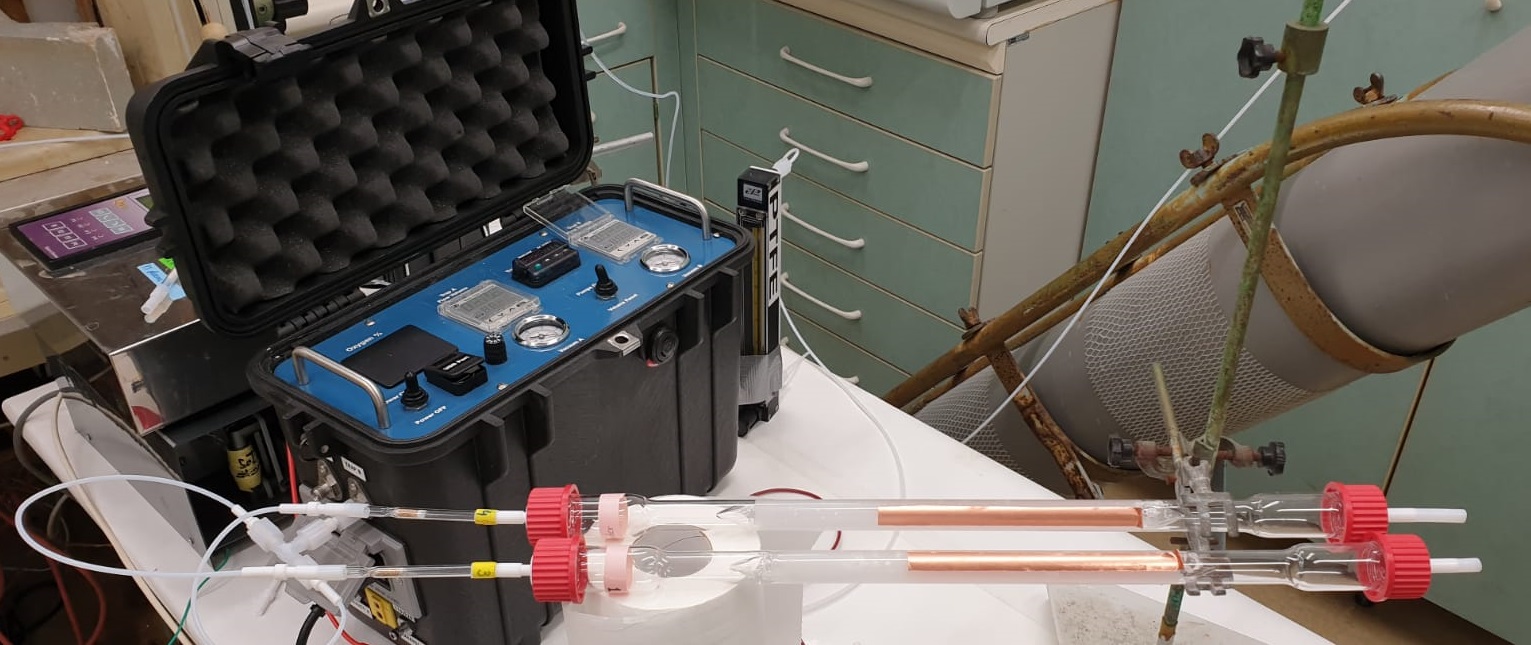


Apart from the interesting laboratory work, Sreekanth is also trained in handling the Tekran speciation unit used for online Hg air measurements together with ESRs 9 and 10. He has volunteered for weekly maintenance of the Tekran speciation unit under the supervision of Dr. Jože Kotnik, which is now placed in Ljubljana city.
Sreekanth is looking forward to attending further training offered by GMOS-Train, the winter school ERCA in France, and going for his planned secondments in coming months.

Tavvavuoma Field Campaign 2021
During this field campaign GMOS Train PhD student Charlotte Haugk (ESR 8) and her supervisor Sofi Jonsson (WP3-lead) went to camp for 2 weeks in the peatlands of Tavvavuoma, an isolated permafrost site in northern Sweden. The field campaign was initiated by Julia Wagner (PhD student at Horizon2020 Nunataruyk project), who will estimate carbon stocks in area studied. In earlier studies, the amounts of carbon stored in Arctic permafrost soils have been used to map and estimate the stocks of total mercury. Based on the data generated from this field campaign, Charlotte and Sofi will together with a master student test if data on carbon, total mercury and the type of landscape can be used to map and estimate stocks of methylmercury in permafrost soils.


The team spent the first week together with Britta Sannel (Department of Physical Geography, Stockholm University) and her master students Ida Rehn and Fabian Seemann at the first sampling site “Tavva South”. Helen Ahlbom, a photographer and artist, also joined the team for the first few days. The second week was spent at the second sampling site “Tavva North”, where Julia and Charlotte continued to collect soils cores.
During the two weeks in the field, 39 soil cores were sampled. These were collected by digging soils pits and hammering stainless steel pipes into the frozen part of the ground. In addition to the soil cores sampled, Charlotte and Sofi also collected water samples and measured the depth of the active layer (top layer of soil that thaws during the summer and freezes again during the autumn). They also collected leaves from the vegetation to study foliar Hg uptake from the atmosphere in collaboration with ESR9 Saeed Waqar Ali (also part of WP3)
Now, Charlotte and Sofi will have one week at home before they go to a second fieldwork this season at Abisko Research Station.


Figure 4: Impressions from the field: coring peat and permafrost and filtering water (Photos by Charlotte Haugk).

Molecular mimicry at play
Mercury is a global pollutant in which methylmercury (MeHg) is the most notorious of all other chemical species. MeHg, after entering the bloodstream, binds to the Sulfhydryl groups (SH- groups) present in the cysteine amino acid (Sulfur-containing amino acid).
It is a molecular mimicry at play; MeHg disguises itself as methionine, the universal start codon for mRNA transcription to protein in living systems. As quoted in the art of war by Sun Tzu, “Kill an enemy using its own weapon/strategy”. We are functionalizing our nanomaterials with SH- groups to adsorb MeHg from an aqueous solution.
As a Early-stage researcher (ESR 11-Allwin Mabes Raj) of the GMOS-Train project received training in synthesizing and stabilizing nanomaterials. I has synthesized nine different nanomaterials so far, which will be used for the adsorption of Inorganic mercury (Hg2+) and methylmercury (MeHg) from the aqueous solution.
Transmission electron microscopic images of the silica nanoparticles without a functional group (Figure.1), silica nanoparticles with an amino-functional group (Figure.2) and silica nanoparticles with a mercapto functional group (-SH) (Figure.3) are depicted below.
The prepared nanomaterials are used for preconcentration of Hg2+ and MeHg ions in the aqueous solution. The nanomaterials can be designed to mask specific mercury species, which can be interferences when detecting MeHg using the Nano-biosensor. The nanomaterials have many applications, especially in biosensing MeHg, increasing the sensitivity to several magnitudes. I have these synthesized nanomaterials in the Institute of Environmental Protection and Sensors, Slovenia, my host institute.

The main objective as an early stage researcher will be carried out in Institute Josef Stefan, Slovenia, which is to understand the process of sensor development, which involves interdisciplinary topics and includes some knowledge from the material and nanomaterial science photonics, chemicals, optical indicators as well as molecular-biology. My main goal is to design an appropriate nano-biosensor for MeHg detection, which should be very sensitive (to detect very low MeHg concentration), selective (to detect MeHg and no other species of mercury).
By Allwin Mabes Raj (ESR 11)

Koketso and Charikleia in “Navagio, Shipwreck”, Zante, Greece
ESR 14 and ESR 15 join every week the online Modeling Group meetings of Work Package 5. These meetings are held by Dr. Johannes Bieser (Heroen) and Dr. Ian Hedgecock (CNR-IIA) and serve as a forum for creative thinking, discussion, and idea generation, resulting in clear action plans and next steps for moving modeling work forward. Currently, Koketso is analysing long-term atmospheric mercury observations from multiple monitoring stations across the globe. Together with meteorological variables and other trace gases, she is studying the patterns in these datasets to try and understand how ocean-atmospheric processes influence atmospheric mercury. Charikleia is currently conducting an extensive analysis of mercury deposition patterns using GEOS-Chem transport model and a number of numerical experiments led by four different anthropogenic mercury emission inventories. The results of the models’ simulations will be compared with available measurements. In August, Koketso and Charikleia decided to meet in person in Greece, taking advantage of the multicultural and collaborative environment of an ITN project. Charikleia says “It was nice to meet Koketso in person and we visited my country together. For me, one of the most interesting parts of the ITN GMOS-Train is that all ESRs work on the same subject and can work closely together and learn from each other.”
By Koketso Molepo (ESR 14) and Chariklea Gournia (ESR 15)

GMOS Train network presented at the virtual Goldschmidt 2021 conference
The GMOS Train network was well presented at the virtual Goldschmidt 2021 conference. On the last day of the conference, there was a session about mercury dynamics and the effectiveness evaluation of the Minamata Convention. Within this session, 5 ESRs presented their upcoming publications, early results and the overall scope of the marine work page. Not only ESRs represented the GMOS Train project at the Goldschmidt 2021. As a Keynote speaker, Milena Horvat presented the overall GMOS Train project and Johannes Bieser shared a new biogeochemical coupled Hg speciation model for the Baltic.
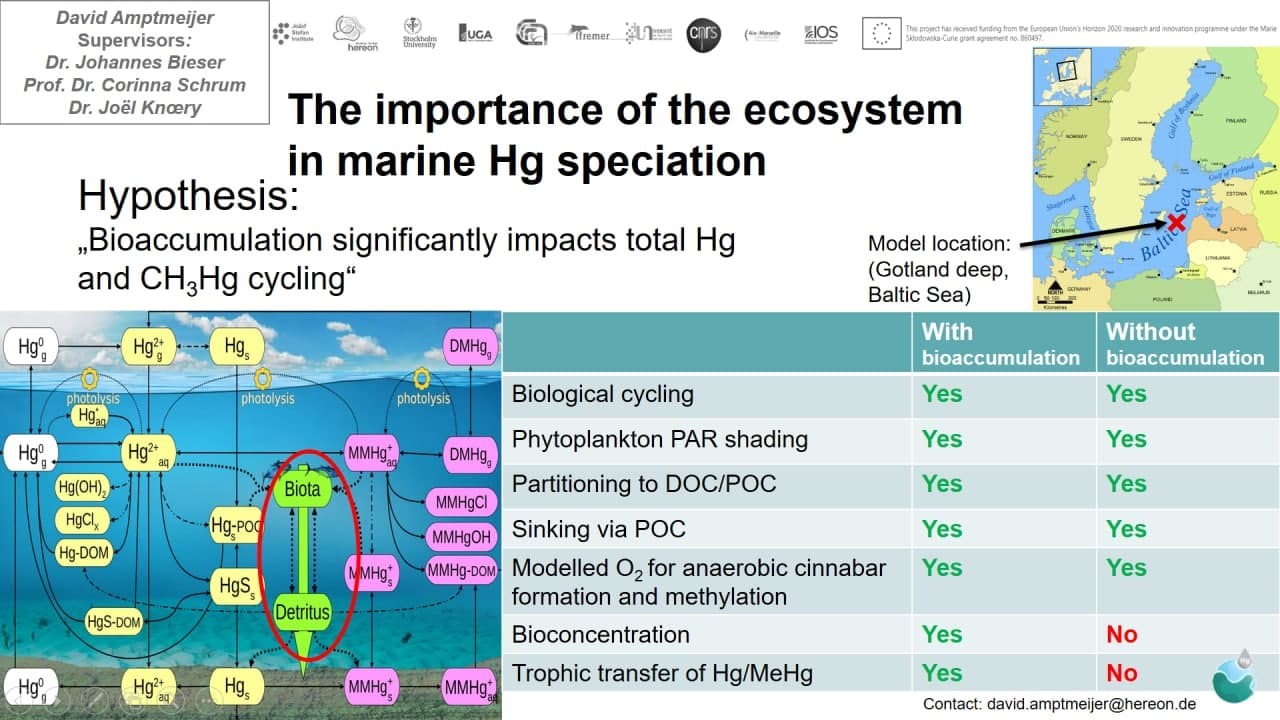
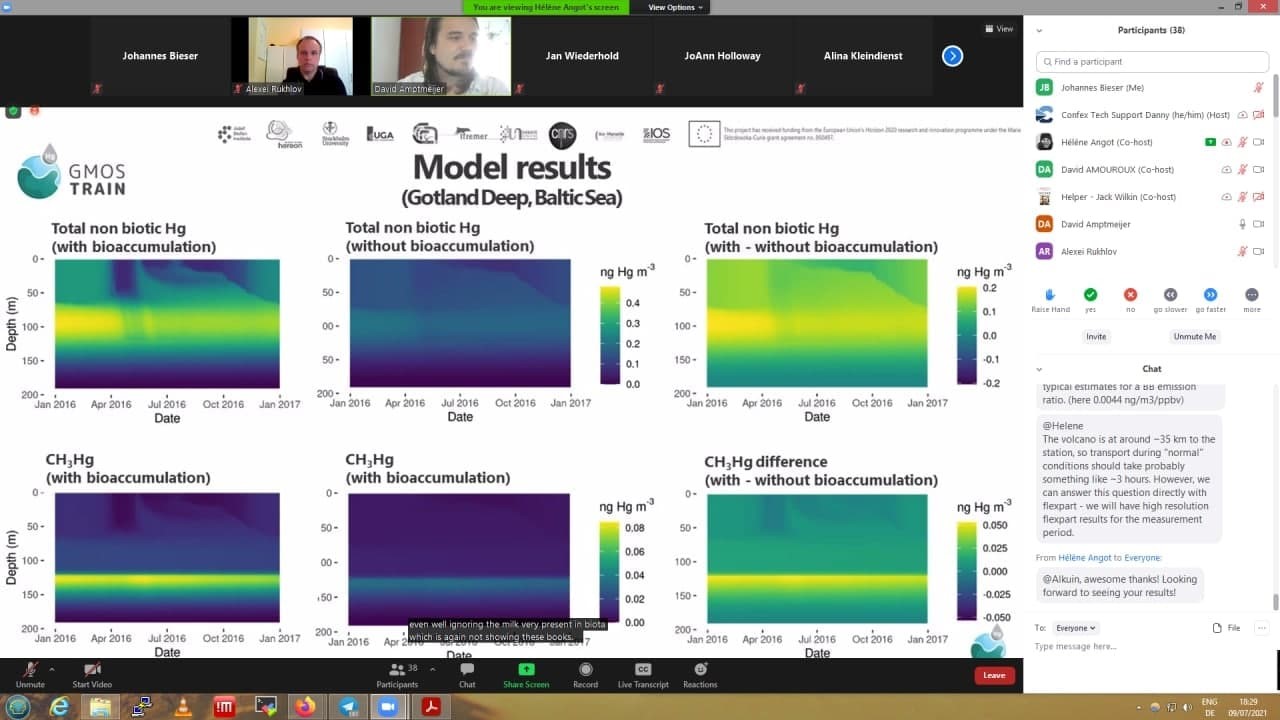
The first of the ESRs to present was Luisa, who presented her progress on carbon and mercury stable isotope fractionation during aqueous MeHg photoreduction during the morning session. She was followed in the afternoon by Alkuin, who showed his upcoming publication about redox dynamics of atmospheric mercury at Maido Observatory in the tropical Indian Ocean. After him came Alina, who talked about her work and first results on evaluating Hg incubation experiments in seawaters using isotopic tracers. Then David presented the model he designed and his early results about modelling Hg and MeHg bioaccumulation in the ecosystem of the Southern Baltic sea. As the last ESR talk, Sonja showed an overview of the marine work package of GMOS Train and the ESRs projects related to this topic and how it all fits together.
Despite the unfortunate complexity of the conference being virtual, it was a great opportunity for both formal and informal interactions with other researchers around the world and it was great to see the amount of progress that was being made in Hg science. But in the end, we all agreed that we could not wait until we could finally meet each other in an in-person meeting.


By David Amptmeijer (ESR 13)

Developing a 1D Hg/MeHg bioaccumulation model
Despite the pandemic, good progress was made developing a 1D Hg/MeHg bioaccumulation model. The idea of this model is that looking at ecosystem interactions in a simplified context allows to identify the driving processes for Hg/MeHg bioaccumulation. Due to the high performance of the 1d model, I can include all theoretical processes and perform a plethora of sensitivity runs wihtin a short timeframe. Moreover, getting rid of the advection signal allows to look at the ecosystem and bioaccumulation in isolation before making the leap to 3D modelling. This model will first of all help by increasing the understanding of interactions between mercury and the ecosystem, and additionally, it will help to make an easier transition to 3D models and save work and computational time down the line.
Currently, the model is parameterized for the Baltic sea and we model the uptake in 3 groups of phytoplankton and how it accumulates to micro-and-mesozooplankton. 2 groups of fish and macrobenthos are additionally ready to be added when we look at higher trophic levels. On top of that, the model is designed in a way that it can easily be transferred to different oceans by changing some key biogeochemical and hydrophysical parameters. Plankton receives most of the attention right now, as understanding what happens at the base is essential for understanding the rest of the food web, and I want to make sure that the basis is good. There is still work to be done, but the model is already presented at the Goldschmidt 2021 virtual conference and I have started working on the first publications..
Of course, the pandemic did cause some complications in combining family life with home office, as our 1-year-old prefers playtime over work time. But child care is available since June and we make it work, as we know we are not the only family in this situation.
To make the home office a bit nicer, I got some colourful attributes from my family, but despite the vivid work environment, I cannot wait until office work is at least partially resumed.
By David Amptmeijer (ESR 13)

Including the atmospheric reactions of mercury in the atmosphere is not simple

Although the WRF-Chem model is conceptually relatively straightforward the details are less so. Updating the chemistry routine to include the atmospheric reactions of mercury in the atmosphere is not simple, especially as it seems that new updates are published every couple of months, “Improved Mechanistic Model of the Atmospheric Redox Chemistry of Mercury” Shah et al., ES&T, Article ASAP, DOI: 10.1021/acs.est.1c03160, published online on August 17th, 2021!
The next problem to solve is the linking of recently described photochemical reactions in the reaction scheme to the photolysis routine, and solar radiation intensity calculation scheme. More news to follow…..
For testing purposes, we are currently working on a relatively simple (and low resolution) domain which covers Europe and the Mediterranean, with a higher resolution nested domain over where we work!
By Prasad Shelke (ESR 12)

Tackling uncertainty of measurement results for gaseous elemental mercury (GEM) calibration

Currently I am comparing the mercury concentrations given by the gas standard calibrator unit with the traceable NIST 3133 CRM (certified reference material), in order to establish the best conditions in which the gas calibrator units can be used. The training I had at the Jožef Štefan Institute in Ljubljana, under the supervision of Prof. Dr. Milena Horvat and co-supervisor Dr. Warren Corns from PS Analytical Ltd has given me the knowledge and confidence to carry out this task.
Shortly after arriving in Slovenia, I had the opportunity to see it´s beautiful landscapes, while also having a look into some of the interest locations for mercury research. I found out about the old mercury mine in Idrija and the cement plant in Anhovo, the latter being subject to atmospheric mercury analysis: gaseous elemental mercury (GEM), gaseous oxidised mercury (GOM) and particle-bound mercury (PBM) being monitored.
Having in mind that GEM is used to calibrate the devices analysing these mercury species, we took a look into the GEM calibration units that are commonly used for the calibration purpose. These devices use the known Dumarey equation which describes the mercury saturation in air at different temperatures. Even though the equation has been established a few decades ago, there are still some discrepancies reported, regarding how well the mercury concentration calculated through the Dumarey equation matches the real concentration at the given temperatures.

By Teodor-Daniel Andron (ESR 10)